Lab · grams
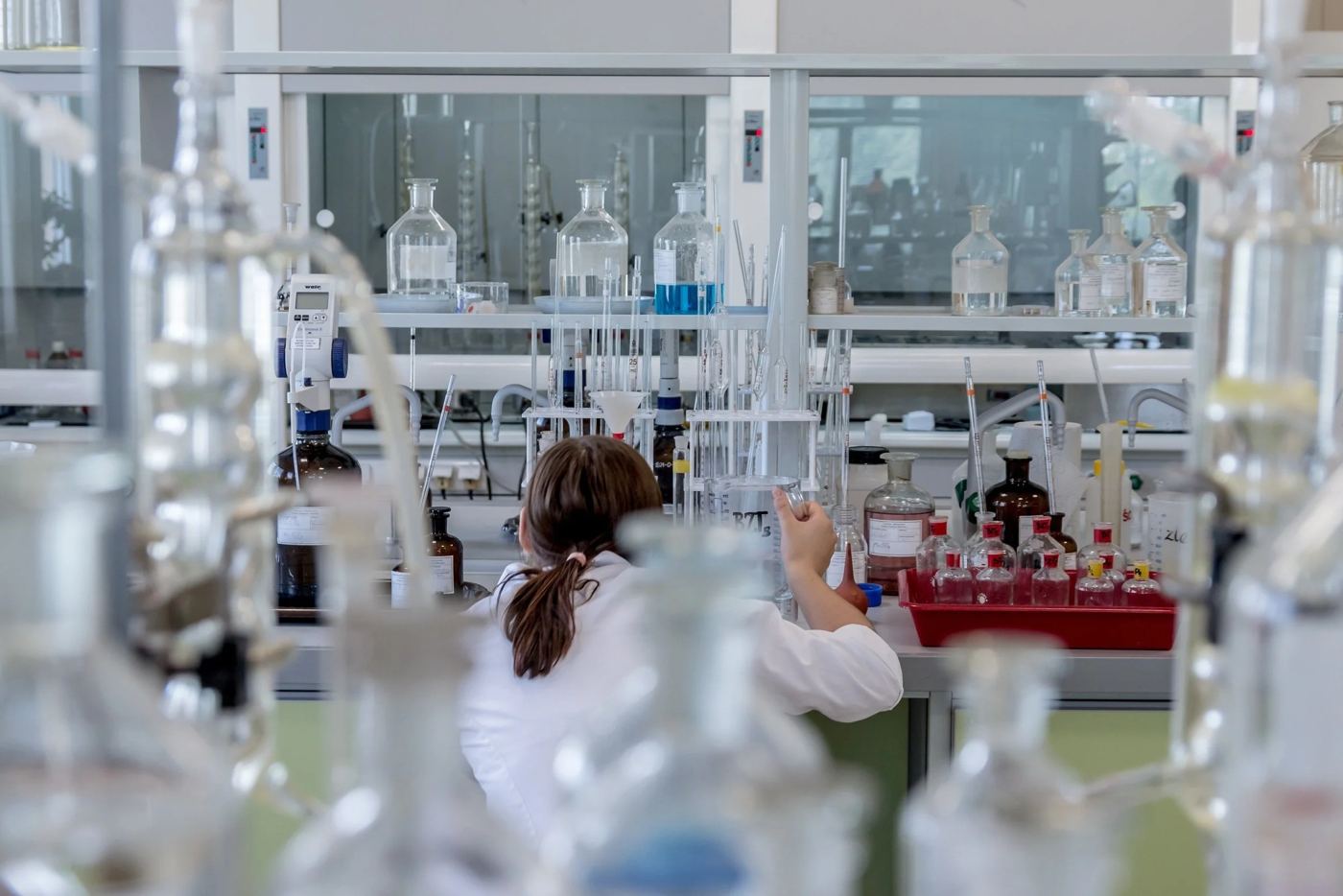
New chemistry works at the bench.
Chemists prove a reaction in glassware. Robots, an analyser and the models record every run, so the pilot starts from data, not guesses.
Pilot · kilograms
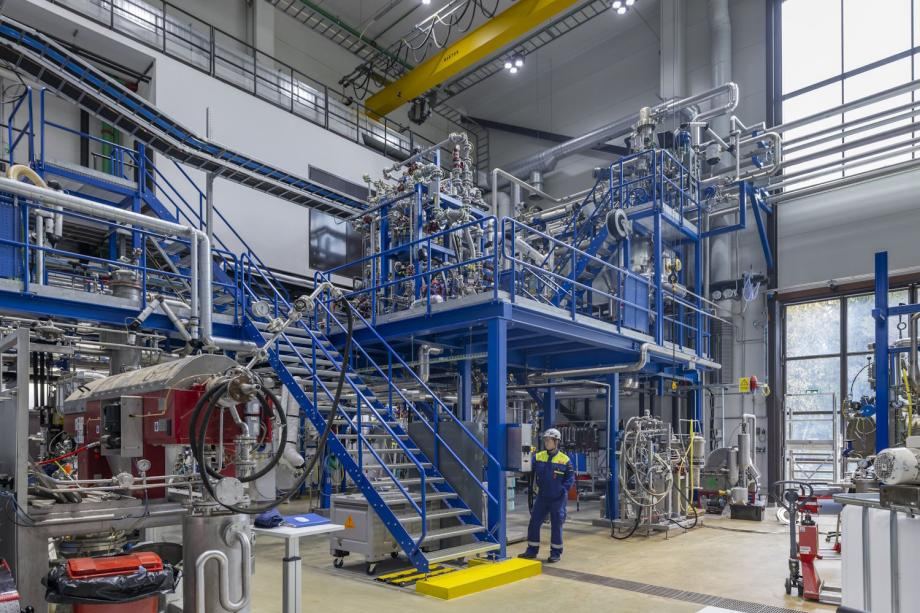
Equipment, operating window and durability get tested.
The same chemistry, ten to a thousand times bigger, on a rig built to be changed. A crane swaps parts and sensors log everything.
Production · tonnes
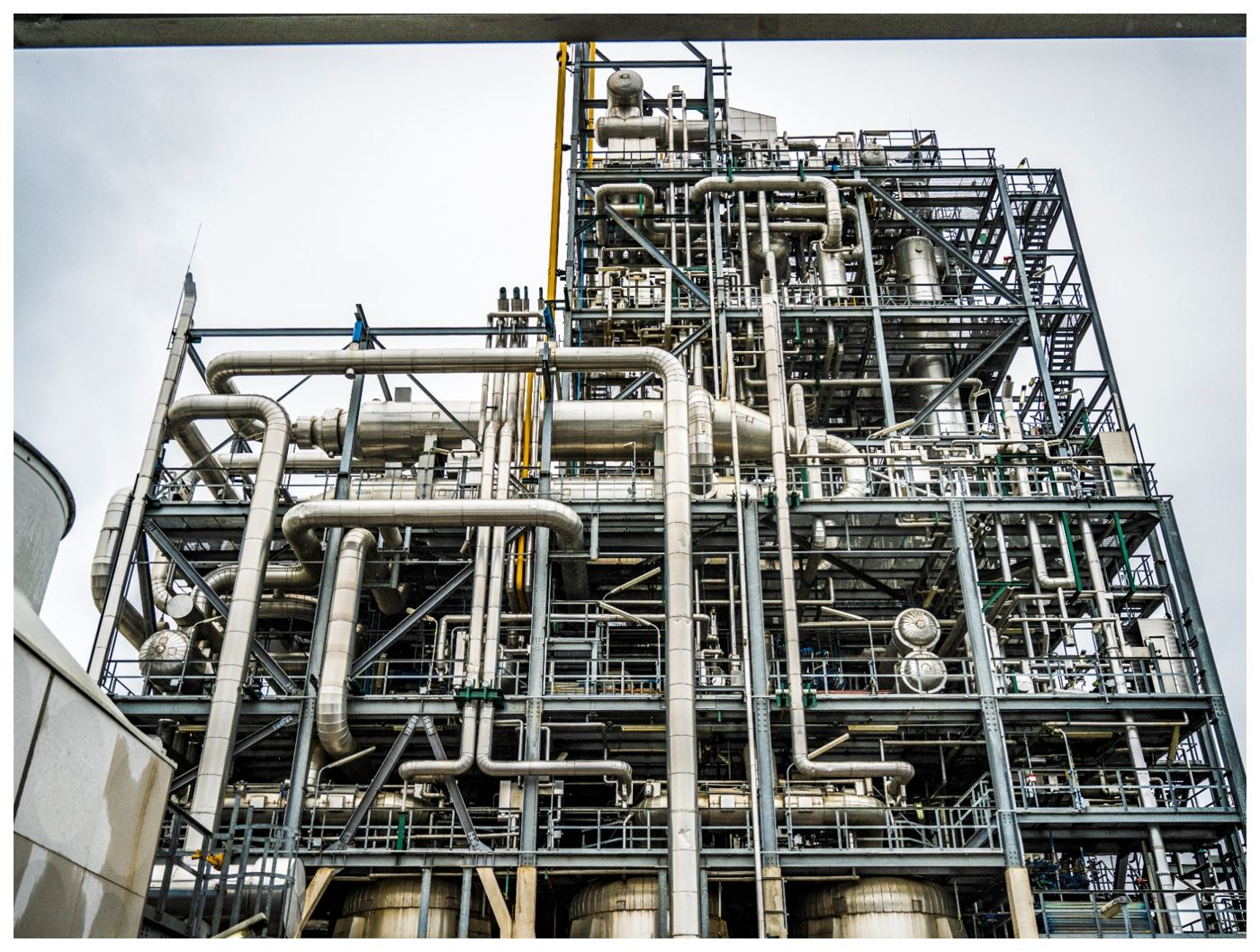
The process has to run reliably, every day.
Columns, coolers and tanks run around the clock. What the plant does feeds back to the models that designed it.
Logistics · drums and pallets
Packed, stacked and shipped by robots.
Finished product is filled into drums, stacked on pallets by an arm, racked by a driverless forklift and counted by a humanoid, then shipped.
University
Teach scale-up with the tools industry uses.
Education is how most engineers will meet RARE first. Students learn on the same simulators and workflows they will use at work.
Lecture theatre. Scale-up taught live, with a teaching robot running the demo rig.Simulation lab. Students describe a process, and an AI copilot builds and runs it.Unit-operations lab. Why a flask result can fail in a plant, and how engineers fix it.Library. Student, course and campus licences.
Click a building on the campus, or step through the numbered sections.
Lecture theatre
Scale-up 101, taught on the real tools.
The lecturer builds a process live on the big screen while a teaching robot runs the demo rig at the front.
Next slide
Try a question
You scale a reactor up to 1,000 times the volume, same shape. How much cooling surface does each litre have now?
About the same
Half as much
A tenth as much
A thousandth as much
See it in the scale explorer
Simulation lab
Describe a process. The copilot builds it.
Students describe a process, and an AI copilot builds and runs it in the simulation software your university already licenses.
Ask the copilot
Unit-operations lab
Why a flask result can fail in a plant.
They see why a reaction that behaves in a flask can fail in a plant, and how engineers fix it, on a teaching rig that behaves like the real thing.
Run the teaching rig
Try the scale explorer
Library · licences
Student, course and campus licences.
Runs on desktop, on university licences. Student, course and campus licences.
More than 200 people are on our waitlist, and we are in discussion with schools.
Bring RARE to your course
Software vendors
An agent that works inside your simulator.
Engineers describe the job once. The agent drives each tool through its own interface and passes the results to the next one.
Live today in Aspen Plus V14, with NDAs signed with vendors.
Licence-aware. Users only reach the tools and models they already pay for. Vendors stay in the loop and keep getting paid.Your own agents and models, and clients' in-house models, plug in alongside ours.
The agent at work
RARE agent Converged
Cool this light-hydrocarbon gas and split it into vapour and liquid at 10 bar.
Chose the Peng-Robinson property method, suited to light hydrocarbons.
Added feed: methane, ethane, propane and n-butane at 60 °C.
Added a cooler with the outlet set to 5 °C.
Added a flash drum at 10 bar.
Ran the simulation. Converged in 6 iterations.
Mass balance closes. Ready for engineer review.
Watch the screens on the desk build the flowsheet. Simplified example; numbers are illustrative.
Inside Aspen Plus
Live today in Aspen Plus V14.
Actual recording: the agent builds a process model in Aspen Plus V14.
NDAs are signed with vendors. The agent works through each tool's own interface, so nothing about your software has to change.
Partner with us
Bundle agents with your product.
Licence-aware. Users only reach the tools and models they already pay for. Vendors stay in the loop and keep getting paid.Your own agents and models, and clients' in-house models, plug in alongside ours, on the model server.
Partner with us to bundle agents with your product.
Talk to us about a partnership
AI
Models that learn what the plant will actually do.
Simulators know the physics, but not your plant. We pair them with machine learning trained on real lab and pilot runs, and say how sure we are.
The dashed arc is the loop: data from the plant flows back to the models in the lab. Click it, or step through the sections.
Orchestrator
Plans the work and checks every result.
The orchestrator plans the work, hands each task to the right agent, simulator or model, and checks every result.
Send a data burst
Language agents
Agents that use the engineer's software.
They build flowsheets, fix runs that won't converge, choose property methods and review each other's work.
Watch an agent build a flowsheet
Specialty models
Predict what simulators can't.
New molecules, real equipment, and what changes with scale.
92% Simulator yield, ideal physics
−
8% Correction learned from pilot data
=
84% ± 4 What the plant is likely to do
The learning loop
Run the loop, then watch the prediction tighten.
Design Simulate Build Run Learn
Predicted yield range narrowing toward the measured yield over five loops
Illustrative data.
Run loop 2 Start over
Private by default
Your hardware, your data.
Runs on your hardware or private servers, with no lock-in to any one model.
Retrain on new data
Robotics
Engineers choose the direction. Robots do the repeatable work.
The lab doesn't need humanoid robots. It needs an assembly line of automated machines. Robots earn their place at pilot scale, building up the rig and moving equipment, driven by real experimental data.
Automated lab and pilot systems assemble, instrument and run the rig.
Sensors on everything, so every run becomes data the models learn from.
Ask the AI how a new pump compares with the one installed, then have a robot fit it.
Click any robot in the plant: arms and a liquid handler in the lab, humanoids, a robot dog, a drone, a climbing robot, a palletising arm and a robot forklift.
Roadmap
From agents today to robots that build plants.
Today Agents run simulations end to end in the software engineers already use. Early 2027 Automated lab and pilot runs, with sensors on every rig. Later Robots that rearrange pilot equipment and install new units, then help build and commission plants.
See the future: robots building labs
Manufacturing
Scale new chemistry with fewer surprises.
A result at the bench does not yet prove a plant. The expensive questions appear between scales.
Which equipment works?
What changes at higher throughput?
What can run reliably for long enough?
Why scale-up is hard: drag the slider
The reactor drawn to scale at the chosen size, with a person or ruler for reference
Volume 0.5 L
Vessel width 8 cm
Cooling surface per litre, vs the flask 100%
The 3D view follows the slider: lab reactor, pilot reactor, plant columns.
What we offer
Scale-up studies. Test a lab recipe in simulation and fix it before hardware is built.Platform licences for process and R&D teams, hosted or on your own hardware.Pilot programmes from 2027. Automated lab and pilot runs, quoted per process.Your chemistry stays private. What we learn about equipment and scale-up improves the models.
Talk to us about your process
Where scale-up is needed now
Area Why now
Drug ingredients (APIs) 100% tariff unless made in the US (2026–2030)
Biomanufacturing US commission calls for national scale-up plants
Chip chemicals and gases About 60% lack US supply; demand $4B to $13B by 2030
Rare-earth magnets US defense ban on Chinese magnets from Jan 1, 2027
Gallium, germanium, antimony China's export-ban pause ends Nov 27, 2026
Battery materials China's battery export controls may return Nov 2026
Explosives No US TNT since 1986; a new Army plant is underway
Nuclear fuel Russian uranium fully banned in the US from 2028
Sources: Reuters via Pharmuni (Aug 2026); Warren Averett; US Census via FRED; Atradius (Feb 2025); Arnold & Porter (Apr 2026); NSCEB; McKinsey (Mar 2025); Tech Times; Fastmarkets; CFR (Sep 2026); Thomasnet; NucNet (Jul 2026).
Investors
Discovery got fast. Building plants did not.
The bottleneck has moved from finding new chemistry to building it.
Supply shocks +30% Plastics prices within days of the Hormuz closure
China builds faster 59% Of the world's new factory robots went to China in 2025
Know-how is the gap 2028 Earliest meaningful US magnet output, despite $7.3B+ committed
The tools are ready $1.4B Raised by Skild AI for robot "brains" in January 2026
Sources: Wood Mackenzie (Mar 2026); World Economic Forum (Apr 2026); QC Intel (Mar 2026); IFR World Robotics (Sep 2026); IEA Critical Minerals Outlook 2025; CSIS (Apr 2026); Tech Times (Oct 2026); Business Wire (Jan 2026).
Reshoring
Plants are coming back to North America.
$500B Pledged by drugmakers for US plants and R&D (2025–26)
100% First-year tax write-off for new US factories started 2025–2028
2× US factory construction vs 2019, at $171B a year
3.8% Yearly US chemical investment growth to 2034, vs 1.5% in Europe
The market
$570M Serviceable today: North America, counted customer by customer
$2.4B Serviceable from 2027: adds pilot builds, pharma, Europe and model licences
$147B Core pool across six spending areas; $472B with plant building and robotics
Our estimates. Counts: US Census Annual Business Survey, ISED Canada, Citeline, Carnegie. Pools: Cefic, Grand View Research, Zion, Market Research Future.
Competition
The connection between stages is the opportunity.
Tool category Discovers chemistry Runs simulators Lab and pilot data Scale-up models
Discovery labs Yes No Lab only No
Simulator vendors No Yes No Partial
Scale-up AI No Partial No Yes
RARE today No Yes Planned Planned
RARE intended loop Yes Yes Yes Yes
Our intended data advantage: paired lab and pilot evidence from the same process.
Business model
Projects pay first, then data, models and IP.
Now Software and studies Scale-up studies, platform licences and grants.2027–2028 Pilots and data Pilot programmes, success fees and paired lab-pilot data.2029 onward Models and IP Model licences, process royalties and our own products.
Milestones
Working software, with the physical loop next.
Today Simulation agents live. 200+ users on the waitlist. Vendor NDAs signed. Early 2027 First paid pilots. Automated lab and pilot runs, and a facility data agreement. Over 24 months A repeatable scale-up loop, with paying clients and documented case studies.
Pre-revenue today. Pilot dates and commercial milestones are targets.
We are raising our seed round. Round details are in the deck.
Request the deck
Future
Robots that build plants. On Earth, then beyond it.
The same loop of models, robots and real data that scales chemistry on Earth can build and run plants where people can't easily go. Click the Moon, Mars, the asteroid or the orbital lab in the sky, watch robots assemble a plant, or see them board a rocket at the launch pad.
Now to 12 months An agentic platform across every integrated simulator. 1 to 3 years Models trained on paired lab and pilot data no one else has. 5 to 10 years Self-driving labs and plants with sensors on everything. Beyond Robotic plants on the Moon and Mars, mining on asteroids, and zero-gravity chemistry in orbit.
On Earth · building the lab
Humanoids build the lab.
Humanoid robots carry and fit the wall panels and weld the frame, while a crane sets each roof module. No one on site but the robots.
Fast-forward the build
On Earth · running the lab
Robots run the lab they built.
Inside the finished lab, humanoids work the benches, an arm handles samples, and mobile robots carry results to the plant next door.
Run an experiment
Self-assembling plants
Robots build the next plant, module by module.
Prefabricated modules roll out of the factory on robot carriers: a jacketed reactor skid, three column sections, a heat exchanger, a pump skid and two tanks. A gantry sets each one on its foundation.
A climbing robot welds the column seams. A mobile arm slides the tube bundle into the exchanger.
Two humanoids carry and bolt the pipe spools, and the arm welds each joint.
Then the plant is commissioned: lamps go green and product starts to flow, guided by data from the last plant.
Fast-forward the build
Recursive self-improvement
That is the R in RARE.
AI, robotics and chemistry improving each other. The system proposes, tests and proves improvements to its own models, tools and robots. Every unit the robots build sends its data back up the loop, so the next one is designed better.
Send results up the loop
On Earth · the launch pad
Robots board for the Moon.
Humanoids ride the tower lift, cross the crew arm and climb into the capsule. Mobile robots bring the cargo: plant modules for the Moon base. Press Launch when they are aboard.
Launch
In the sky · the Moon
A Moon base that makes its own oxygen.
An excavator with two counter-rotating drums digs regolith and tips it into a hopper. A reactor melts it and splits out oxygen, which is liquefied and stored in tanks. Tall solar towers follow the low Sun, and radiators shed the heat.
At the landing pad a rover hauls new modules off the lander, a gantry sets them in place, and humanoids bolt them together.
Fast-forward
In the sky · Mars
Rocket fuel from air and ice.
Compressors pull carbon dioxide from the thin air. A drill rig mines buried ice, and a rover carries the water to an electrolyser that splits it into hydrogen and oxygen. A Sabatier reactor joins the CO2 and hydrogen into methane.
The methane and oxygen fill the tanks that refuel the rocket home, while a robot prints shelters from the soil and a welding arm builds the next tank.
Fast-forward
In the sky · an asteroid
Mining and refining on an asteroid.
A bucket-wheel robot digs ore from an open pit, and a conveyor carries it to a small refinery tied to the rock. A crusher and a magnetic separator split out the metal-rich grains, and a dish that tracks the Sun focuses its heat to smelt them and bake out water.
An arm loads the refined metal into pods, and a mass driver of magnetic coils throws them toward Earth orbit. With almost no gravity, everything is anchored and the dust just drifts away.
Launch a pod
In orbit · zero-gravity chemistry
Specialty molecules made in zero gravity.
With no gravity there is no settling and no convection, so drug crystals grow larger and more even, and droplets mix without touching a container. Robot arms tend the floating drops in the glass lab, and each finished batch goes home in a return capsule.
Robots keep the station itself running too: an arm refuels a satellite, a drone inspects it, and a humanoid works on the truss.
Grow a crystal batch
About RARE Labs
We help new chemistry reach the plant.
RARE Labs builds AI and robotics for chemical scale-up: the slow, costly step between a result at the bench and a plant that runs every day.
The problem. Discovery got fast. Building plants did not. The bottleneck has moved from finding new chemistry to making it.Today. Our agents run process simulations end to end, live in Aspen Plus V14.Next. Automated lab and pilot runs, so every scale-up produces data the models learn from.
The plant behind this card is the whole idea in one picture: lab, pilot, production and logistics, joined by one learning loop.
The name
Recursive AI, Robotics and Engineering.
Recursive because the loop feeds itself. Every lab run, pilot run and plant day improves the models that design the next one.
R Recursive. Results flow back up the loop, so each design starts from what the last one did.A AI. Agents that drive the engineer's software, and models that predict what the plant will do.R Robotics. Machines that do the repeatable work, from the lab bench to the pilot rig.E Engineering. Engineers stay in charge and approve every design.
Send data round the loop
How we work
Five rules we build by.
Engineers stay in charge. AI and robots do the repeatable work.A range, not one number. Every prediction says how sure it is, and flags a case that is new.Private by default. Runs on your hardware or private servers, with no lock-in to any one model.Works with your tools. The agent drives each simulator through its own interface, and only the licences you already pay for.Your chemistry stays yours. What we learn about equipment and scale-up improves the models.
Where we are
Working software, with the physical loop next.
Today Simulation agents live in Aspen Plus V14. 200+ people on the waitlist. Vendor NDAs signed. Early 2027 First paid pilots, with automated lab and pilot runs. Over 24 months A repeatable scale-up loop, with paying clients and documented case studies.
Pre-revenue today. Pilot dates and commercial milestones are targets.
Meet the team Get in touch
Step 1 · Describe
An engineer describes the job once.
In plain words: the feed, the target and the limits. The RARE agent turns it into a plan and starts building.
Watch the agent start
Step 2 · Simulate
Agents build and run the simulation.
The agent picks a property method, builds the flowsheet in the simulator you already license, fixes runs that won't converge, and hands it to the engineer to review.
Our models then correct the simulator with what real lab and pilot runs showed, and give a range, not one number.
How the models correct the simulator
Step 3 · Test in the lab
Machines run the experiments.
A liquid handler sets up dozens of small reactions, an arm carries samples to the analyser, and every result goes straight to the models. The molecular view shows the chemistry they have to get right.
Plate a screen
Step 4 · Prove it at pilot scale
Ten to a thousand times bigger.
The same chemistry on a rig built to be changed. Heat and mixing behave differently at this size, so sensors log everything and robots rearrange the equipment.
Start the pilot run
Step 5 · Run the plant
Tonnes a day, around the clock.
Columns, coolers and tanks run day and night. Operators stay in charge, and the AI flags what needs a look.
Run a plant health check
Step 6 · Learn
Every run makes the next design better.
Data from the lab, the pilot and the plant flows back to the models, so each new design starts from what the last plant actually did. That is the R in RARE.
Send a data burst
Questions
Frequently asked.
What does RARE Labs do? We build AI and robotics for chemical scale-up: agents that run process simulations, models that learn from real lab and pilot data, and automated lab and pilot runs.
Does it replace engineers? No. Engineers stay in charge and approve every design. AI and robots do the repeatable work.
Which simulators does it work with? It is live today in Aspen Plus V14. The agent drives each tool through its own interface, so nothing about your software has to change. NDAs are signed with vendors.
Where do the models run? Is my data private? On your hardware or private servers, with no lock-in to any one model. Your chemistry stays private. What we learn about equipment and scale-up improves the models.
How sure are the predictions? Each prediction comes as a range, not one number, with a flag when a case is new. The range tightens as lab and pilot data come in.
Do we need robots to get started? No. Start with scale-up studies and platform licences. Automated lab and pilot runs follow in our pilot programmes from 2027.
How is it priced? Scale-up studies, platform licences for process and R&D teams, and pilot programmes quoted per process.
Can universities use it? Yes. Student, course and campus licences, on the simulators universities already license.
Are you raising? Yes, we are raising our seed round. Request the deck .
Is the 3D plant real? It is an illustrative scene. The physics views are simplified models, and readings are simulated.
Where can I try the software? Reflux, our AI copilot for process simulation, is at reflux.sh .
How do you handle my data? This website sets no cookies and uses no tracking. See our Privacy Policy , Terms of Use and Legal Notices .
Ask us something else
A chemical engineer and an AI chemist.
Process engineering, AI and chemistry, working to speed up scale-up.
Nathan Ruberto Co-founder and CEO Chemical engineering, Waterloo Powertrain simulation at Tesla Nuclear fuel, and pulp and paper
Jon Bell Co-founder and CTO MSc Artificial Intelligence, UCL Years of AI chemistry research Commodities and pharmaceuticals
Help build the next scale-up workflow.
Have a process to take from the bench to the plant, or want to back one? Get in touch.
Try Reflux, our AI copilot for process simulation, at reflux.sh ↗
© 2026 Recursive AI Robotics & Engineering Labs Inc. All rights reserved.
Privacy Policy Terms of Use Cookie Notice Legal Notices
Illustrative scene. Readings are simulated.